Key facts
- Mutable Devotions is a six-part exhibition by NYU Abu Dhabi fine arts graduates at Rizq Art Initiative in Abu Dhabi.
- The exhibition runs until August 31, 2026.
- Nour Elbery’s installation uses aquarium structures and preserved shavings of her skin in formalin.
- Shaima Shamsi’s work references British geological surveys of the Gulf and Bahrain’s Dilmun burial mounds.
- Yuehan Dai’s project uses AI agents and Captcha challenges to question human identity in the digital age.
- Rizq Art Initiative was founded in 2023 and describes itself as an independent, artist-led social enterprise.
A graduate showcase anchored in memory and place
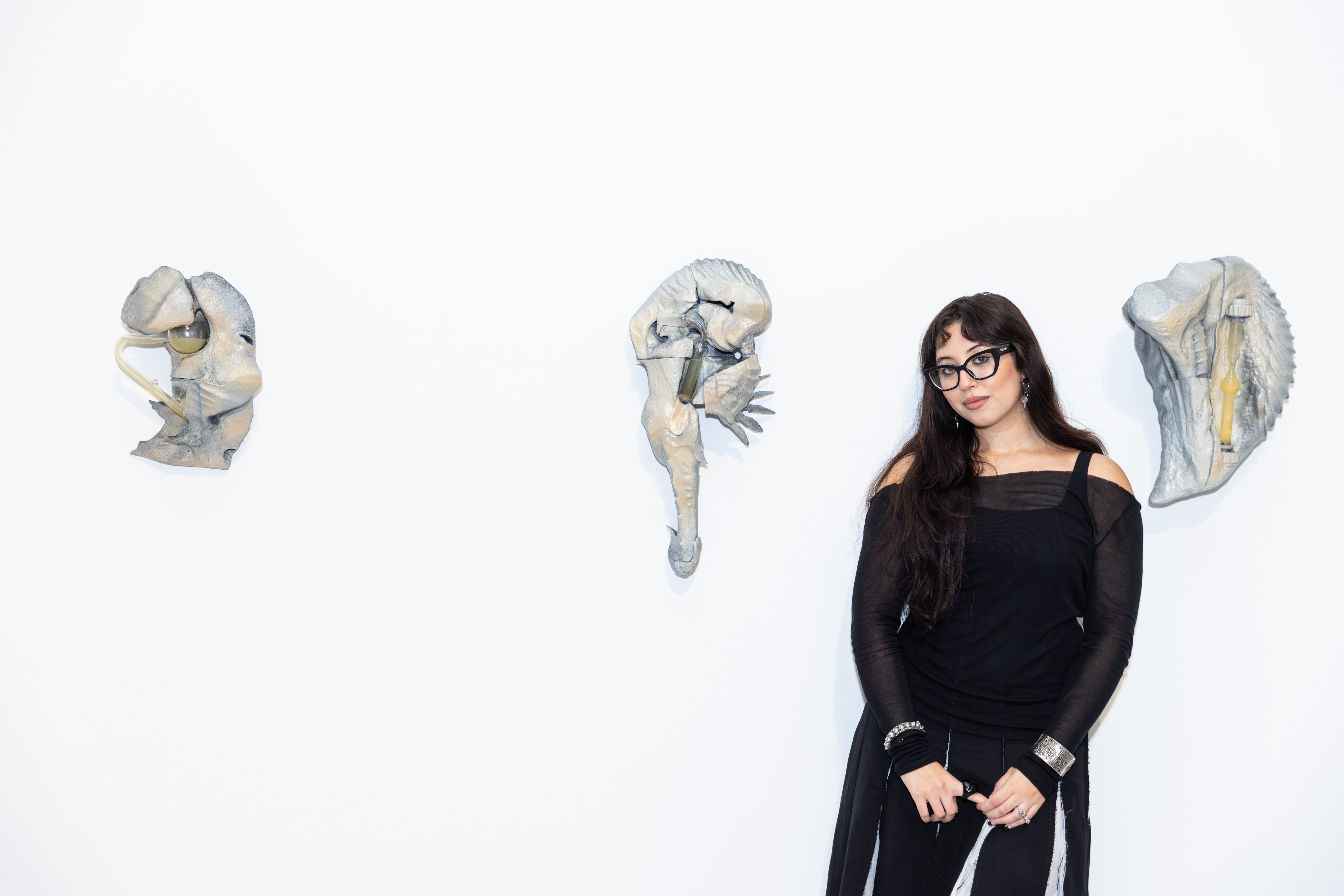
At Abu Dhabi’s Rizq Art Initiative, six fine arts graduates from NYU Abu Dhabi are presenting an exhibition that treats memory not as an abstract theme but as something built from objects, surfaces and systems of belief. The show, Mutable Devotions, runs until August 31 and gathers six smaller exhibitions, each centred on one artist. Rather than present a single curatorial thesis, the project gives each graduate room to test a different way of thinking about belonging, displacement and the traces people leave behind. ([thenationalnews.com](https://www.thenationalnews.com/arts-culture/art-design/2026/08/28/skin-burial-mounds-and-ai-six-nyud-artists-rethink-memory-and-belonging-in-abu-dhabi/?utm_source=openai))
The works described so far move across very different registers. One installation uses aquariums and jars filled with formalin and shavings of the artist’s own skin. Another looks to the Gulf’s colonial survey history and the overlooked legacy of Bahrain’s Dilmun burial mounds. A third inverts a Turing test, bringing AI agents and Captcha-style challenges into play to ask what counts as human in a digital age. The variety matters: the exhibition’s point is not that these works say the same thing, but that they all question how identity is preserved, interrupted or misread. ([thenationalnews.com](https://www.thenationalnews.com/arts-culture/art-design/2026/08/28/skin-burial-mounds-and-ai-six-nyud-artists-rethink-memory-and-belonging-in-abu-dhabi/?utm_source=openai))
Material, body and preservation
Nour Elbery’s installation is among the most striking examples. The National reports that the work features aquarium structures, black steel frames, circulating water, and containers filled with a murky liquid, while Elbery says the jars contain shavings of her skin suspended in formalin, a preservative solution. The piece appears to transform bodily material into an archive, using preservation itself as a metaphor for the attempt to hold on to experience. That framing is supported by the artist’s statement quoted in the report, which presents each work less as a container for objects than as a container for the memory of holding them. ([thenationalnews.com](https://www.thenationalnews.com/arts-culture/art-design/2026/08/28/skin-burial-mounds-and-ai-six-nyud-artists-rethink-memory-and-belonging-in-abu-dhabi/?utm_source=openai))
That idea gives the exhibition an unusually physical emotional language. Instead of treating memory as something remembered only in narrative form, the show appears to ask what happens when memory is lodged in residue, texture and chemical suspension. The aquariums and jars suggest both care and unease: they preserve, but they also isolate. In that sense, Elbery’s work seems to align with the broader exhibition’s concern with preservation under pressure, whether the pressure comes from personal history, ecological change or the institutional habits of collection and display. This is an interpretation drawn from the reported details of the work rather than a claim stated outright by the artist. ([thenationalnews.com](https://www.thenationalnews.com/arts-culture/art-design/2026/08/28/skin-burial-mounds-and-ai-six-nyud-artists-rethink-memory-and-belonging-in-abu-dhabi/?utm_source=openai))
Colonial records, buried histories and the problem of absence
Shaima Shamsi’s contribution takes a different route into the past. According to The National’s reporting, the work refers to British geological surveys of the Gulf from the early 20th century and highlights the way those records often overlooked indigenous heritage, including the Dilmun burial mounds in Bahrain. That historical frame matters because it positions the exhibition not merely as a meditation on identity, but as a critique of the way identity has been documented by outsiders. If a survey map or archival record leaves key people and sites out, then absence becomes evidence of a political order, not just a gap in knowledge. ([thenationalnews.com](https://www.thenationalnews.com/arts-culture/art-design/2026/08/28/skin-burial-mounds-and-ai-six-nyud-artists-rethink-memory-and-belonging-in-abu-dhabi/?utm_source=openai))
Shamsi’s comments reinforce that reading. She describes absence as something that cuts both ways, capable of meaning emptiness while also holding knowledge. That is a concise formulation of what the exhibition seems to be doing more broadly: treating loss not only as deprivation but as a site where suppressed meanings remain active. The burial mounds are especially potent in this context because they are literally forms of memory embedded in land, yet they also stand in for the many ways histories can be present and still be ignored. ([thenationalnews.com](https://www.thenationalnews.com/arts-culture/art-design/2026/08/28/skin-burial-mounds-and-ai-six-nyud-artists-rethink-memory-and-belonging-in-abu-dhabi/?utm_source=openai))
Rizq Art Initiative’s recent programming suggests that this kind of theme fits within a wider effort to support artists thinking about place and social memory in the UAE. The organisation, founded in 2023, has described mentorship, research and interdisciplinary support as central to its work. Its earlier exhibition Under the Same Sky explored how artists living in the UAE make sense of home, and the initiative has presented itself as a platform where different perspectives can coexist without being flattened into one narrative. Mutable Devotions appears to extend that approach into a more intimate and historically charged register. ([thenationalnews.com](https://www.thenationalnews.com/arts-culture/2026/06/17/under-the-same-sky-at-rizq-art-initiative-explores-the-many-ways-artists-call-the-uae-home/?utm_source=openai))
AI, personhood and the digital age
Among the more contemporary references in the show is Yuehan Dai’s project, which reportedly inverts the Turing test by combining AI agents with Captcha challenges. In doing so, the work seems to reverse a familiar logic: instead of asking whether a machine can appear human, it asks what tests humans are now made to pass in order to prove they are not machines. That twist captures a broader uncertainty around digital identity, where automated systems increasingly mediate access, recognition and trust. ([thenationalnews.com](https://www.thenationalnews.com/arts-culture/art-design/2026/08/28/skin-burial-mounds-and-ai-six-nyud-artists-rethink-memory-and-belonging-in-abu-dhabi/?utm_source=openai))
What makes this especially relevant in an exhibition about belonging is that digital systems now shape who gets seen and how. Captchas, verification loops and AI-generated interfaces are not neutral tools; they are gatekeeping mechanisms that sort genuine users from suspicious ones and, in the process, define normality through exclusion. Dai’s work appears to use those structures as conceptual material, turning an everyday friction point into a philosophical question about personhood. That is an inference from the reported description of the work, not a direct quotation from the artist. ([thenationalnews.com](https://www.thenationalnews.com/arts-culture/art-design/2026/08/28/skin-burial-mounds-and-ai-six-nyud-artists-rethink-memory-and-belonging-in-abu-dhabi/?utm_source=openai))
Why this exhibition matters in Abu Dhabi
The exhibition also matters because it sits at the intersection of a university art programme and an independent local initiative. NYU Abu Dhabi’s public programmes confirm the institution’s ongoing exhibition activity in 2026, while Rizq Art Initiative has recently positioned itself as a venue for artist-led and community-facing projects in Abu Dhabi. Together, those contexts give Mutable Devotions a particular charge: it is both a graduate showcase and a public-facing intervention in the city’s cultural conversation. ([publicprograms.nyuad.nyu.edu](https://publicprograms.nyuad.nyu.edu/en/the-art-gallery.html?utm_source=openai))
That dual identity helps explain why the works described in The National’s report feel so rooted in questions of audience and reception. A viewer encountering preserved skin, survey history or AI verification prompts is asked not simply to admire technique, but to confront the frameworks through which bodies, land and intelligence are classified. In that sense, the exhibition does not just revisit memory; it tests the mechanisms that determine which memories become legible and which remain hidden. ([thenationalnews.com](https://www.thenationalnews.com/arts-culture/art-design/2026/08/28/skin-burial-mounds-and-ai-six-nyud-artists-rethink-memory-and-belonging-in-abu-dhabi/?utm_source=openai))
For Abu Dhabi’s art scene, the show also signals how emerging artists are using mixed media to move beyond tidy categories. Ceramics, charcoal, AI, archival references and preserved biological material can all appear in the same curatorial space if the question being asked is large enough. Here, that question is how people belong to places, and how places in turn remain inside people, even when the evidence is partial, damaged or deliberately obscured. The exhibition’s title, Mutable Devotions, captures that instability well: devotion can endure, but it can also change shape. ([thenationalnews.com](https://www.thenationalnews.com/arts-culture/art-design/2026/08/28/skin-burial-mounds-and-ai-six-nyud-artists-rethink-memory-and-belonging-in-abu-dhabi/?utm_source=openai))
Broader context: NYU Abu Dhabi and the city’s art ecosystem
NYU Abu Dhabi’s public programming pages show an active exhibition calendar in 2026, including the NYUAD Art Gallery and related exhibition spaces. That matters because it places the graduates’ work within an institutional ecosystem that has repeatedly used art exhibitions to connect scholarship, practice and public conversation. Meanwhile, Rizq Art Initiative has described itself in The National as an independent, artist-led social enterprise founded in 2023, with a focus on exhibitions, research and support for early-career artists. The collaboration between the two therefore looks less like a one-off event than part of a growing pipeline from university training into the city’s wider art scene. ([publicprograms.nyuad.nyu.edu](https://publicprograms.nyuad.nyu.edu/en/the-art-gallery.html?utm_source=openai))
Seen that way, Mutable Devotions is not only about what six artists made after graduation. It is also about the kinds of questions an art school in Abu Dhabi is helping to produce: questions shaped by the Gulf’s layered histories, by migration and displacement, by the ethics of preservation, and by the accelerating presence of machine intelligence in everyday life. Those are local and global concerns at once, which helps explain why the exhibition reads as both specific to the region and legible far beyond it. ([thenationalnews.com](https://www.thenationalnews.com/arts-culture/art-design/2026/08/28/skin-burial-mounds-and-ai-six-nyud-artists-rethink-memory-and-belonging-in-abu-dhabi/?utm_source=openai))
Sources: