By Brenda Wereh14 Jul, 202529 mins read 2,467 views
0 comments 0 likes
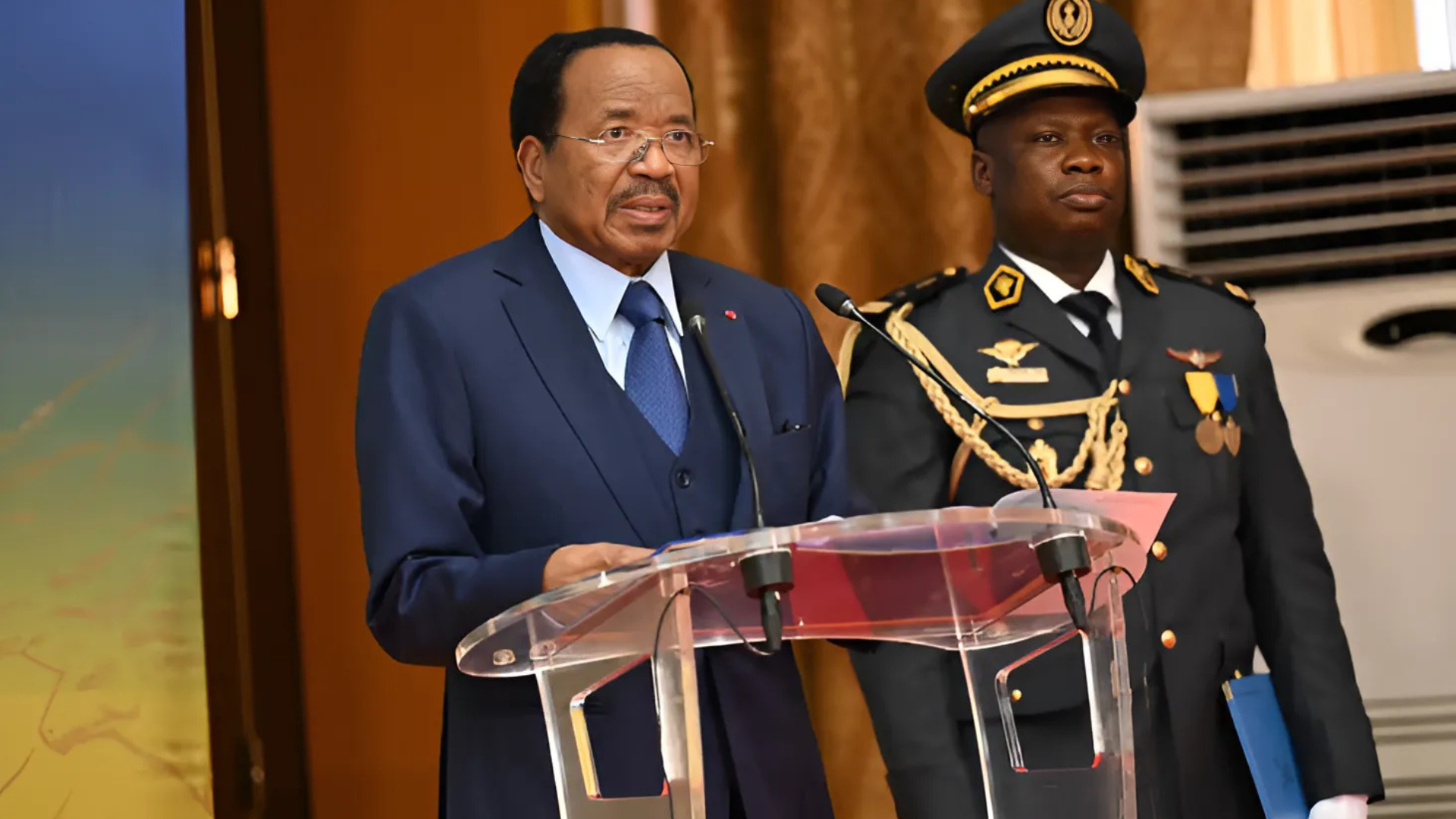
Cameroon’s President Paul Biya, aged 92 and the world’s oldest serving head of state, declared his candidacy for an eighth term in the October 12 presidential election, potentially extending his leadership beyond four decades since 1982.
On a quiet Sunday evening, July 13, 2025, Cameroon’s President Paul Biya, at 92 the world’s oldest serving head of state, took to social media to announce his intention to seek an eighth term in the upcoming presidential election scheduled for October 12. The declaration, posted in both French and English on his official X account, marked a significant moment in the nation’s political landscape, reaffirming his resolve to lead a country he has governed since 1982, when his predecessor Ahmadou Ahidjo unexpectedly resigned. “I am a candidate in the presidential election,” Biya wrote. “Rest assured that my determination to serve you matches the urgency of the challenges we face.” The announcement, though widely anticipated, has ignited fresh debate across Cameroon’s cities and villages, with supporters praising his experience and critics questioning his fitness to lead into his late 90s.
Biya’s political journey began over four decades ago, a tenure that has made him Africa’s second-longest-serving leader, trailing only Equatorial Guinea’s Teodoro Obiang. Born in 1933 in the southern village of Mvomeka’a, Biya rose through the ranks of government under Ahidjo, serving as prime minister from 1975 until his ascent to the presidency in November 1982. His early years were marked by efforts to diversify Cameroon’s foreign relations, a strategy he termed “diplomacy of development,” which strengthened ties with the United States and other nations. Yet, his long rule has been defined by stability for some and stagnation for others, with his latest bid potentially keeping him in office until he nears 100. “He has guided us through tough times,” said Marie Ngono, a market vendor in Yaoundé. “But at his age, can he still lead effectively?”
The announcement comes amid heightened speculation about Biya’s health, a topic that has lingered for years. Last year, his 42-day absence from public view sparked rumors of illness, prompting the government to issue statements denying any serious condition and banning discussions of his well-being as a matter of national security. His rare public appearances—often limited to official photos or brief televised addresses—have fueled concerns, with many noting his delegation of duties to his powerful chief of staff. “We need a leader who can be present,” said human rights advocate Peter Mbida in Douala. “His health is a question we can’t ignore.” Biya’s supporters, however, dismiss such concerns, arguing his experience outweighs age-related challenges. “He knows this country better than anyone,” said Joseph Ngu, a member of the ruling Cameroon People’s Democratic Movement (CPDM).
The CPDM, which Biya has led since its formation in 1985 from the remnants of the Cameroon National Union, has been a cornerstone of his dominance. Party members and coalition partners have publicly urged him to run again, seeing his candidacy as a continuation of stability in a nation grappling with economic difficulties and security threats. Cameroon faces a separatist conflict in its English-speaking regions, where armed groups have clashed with security forces since 2016, and incursions by Boko Haram in the north have displaced thousands. “His leadership has kept us united,” said CPDM official Rose Tchana in Buea. Yet, this stability is contested by opposition figures and civil society, who argue that Biya’s tenure has stifled democratic progress and economic growth. “After 43 years, we need fresh ideas,” said opposition leader Maurice Kamto, who plans to challenge Biya.
Kamto, leader of the Cameroon Renaissance Movement and runner-up in the 2018 election, is among several opposition candidates, including Joshua Osih, Akere Muna, and Cabral Libii, who have declared their intentions to run. These figures have called for electoral reforms to ensure a fair vote, pointing to allegations of fraud in past elections, including Biya’s 71.28 percent victory in 2018 amid low turnout due to violence. Two former allies have also defected, announcing separate candidacies, signaling fractures within the ruling coalition. “This election must reflect the people’s will, not just one man’s ambition,” said Muna, a lawyer known for anti-corruption advocacy. The opposition’s fragmented efforts, however, may struggle against the CPDM’s entrenched control over state institutions, including the electoral commission.
Biya’s decision to scrap term limits in 2008, enabling indefinite re-election, has been a pivotal move in his prolonged tenure. His victories—spanning 1984, 1988, 1992, 1997, 2004, 2011, and 2018—have often been marred by accusations of irregularities, with the 1992 multiparty election seeing him win with 40 percent against a divided opposition. Critics argue this has entrenched a one-party system despite the legal existence of multiparty democracy since 1990. “He’s turned democracy into a personal project,” said young activist Ange Ngandjo in Yaoundé. “We deserve a chance to choose someone new.” Yet, Biya’s narrative emphasizes continuity, with his recent post highlighting the well-being of youth and women as priorities, a message aimed at addressing unemployment and gender inequality.
The social media announcement itself marks a shift, building on his 2018 use of digital platforms to engage the public directly. At 92, Biya’s active presence on X contrasts with his limited physical visibility, a strategy some see as an attempt to connect with a younger, tech-savvy population. Half of Cameroon’s 30 million people are under 19, a demographic increasingly vocal about change. “We’ve never known another leader,” said student Clara Mballa in Bamenda. “It’s time for us to lead.” This sentiment is echoed in posts found on X, where the hashtag #Biya2025 trends alongside calls for renewal, though inconclusive opinions reflect a divided public.
Cameroon’s economic challenges further complicate the election narrative. The country, rich in cocoa and oil, struggles with poverty, with rural areas like the Far North region facing acute hardship. Biya’s government has been criticized for slow development, with infrastructure projects often stalled and corruption allegations persistent. “We need jobs, not promises from the past,” said fisherman Ali Mohamed in Limbe. The separatist conflict, which has claimed over 6,000 lives and displaced hundreds of thousands, adds urgency, with some blaming Biya’s age for his inability to negotiate peace. “He can’t even visit the conflict zones,” said teacher Rose Atangana in Buea. “How can he solve this?”
Supporters counter that Biya’s experience has navigated Cameroon through global shifts, from the Cold War to modern counterterrorism efforts with the United States against Boko Haram. His early tenure saw economic highs, with the U.S. becoming a key export market in the 1980s due to oil. Yet, recent years have seen economic strain, with youth unemployment at 67 percent mirroring regional trends. “He’s our anchor,” said trader Paul Njei in Garoua. “Change risks chaos.” The government’s recent postponement of parliamentary and municipal elections to 2026, citing security, has also raised eyebrows, with some seeing it as a tactic to consolidate power ahead of October.
The succession question looms large. With no clear plan, a potential crisis if Biya becomes incapacitated or dies in office worries analysts. The constitution designates the Senate president to oversee elections within 120 days, but political maneuvering within the CPDM suggests internal battles, possibly involving Biya’s son Franck, who has gained visibility. “We need a transition, not a vacuum,” said civil society leader Nkongho Felix Agbor. Biya’s family, including his wife Chantal, 36 years his junior, remains influential, with their children Paul Jr. and Brenda also in the public eye—Brenda notably as an LGBTQ activist.
As October 12 approaches, the campaign season will test Cameroon’s political resilience. Registration for over seven million voters concluded in August 2024, setting the stage for a contentious vote. Biya’s party prepares rallies, while opposition figures plan to mobilize, though past crackdowns on protests loom. “We’ll vote for change, peacefully,” said Kamto, reflecting a cautious optimism. In villages like Mvomeka’a, where Biya’s legacy began, residents like elderly farmer Etienne Mvondo watch with mixed feelings. “He’s one of us,” Mvondo said. “But the country needs new blood.” As the nation braces for this pivotal election, the balance between continuity and renewal hangs in the balance.
Former Kiambu Governor Ferdinand Waititu has secured a major bail reprieve from the High Court, with Justice Winfrida Okwany reducing his bail from Sh53.5 million to Sh20 million cash pending appeal in his ongoing corruption case.
President Ruto and Governor Sakaja signed a cooperation agreement allocating funds for 50,000 new streetlights, water plants saving 50 million litres daily, 27 km Nairobi River sewer and ward road upgrades, with Ruto calling it a partnership to make the city livable while opposition senators warn of devolution threats.
A staff member at Moi Teaching and Referral Hospital allegedly stole Sh10 million by falsifying patient bills as paid in the eCitizen system while diverting the money to her personal account, prompting an ongoing police and hospital investigation.